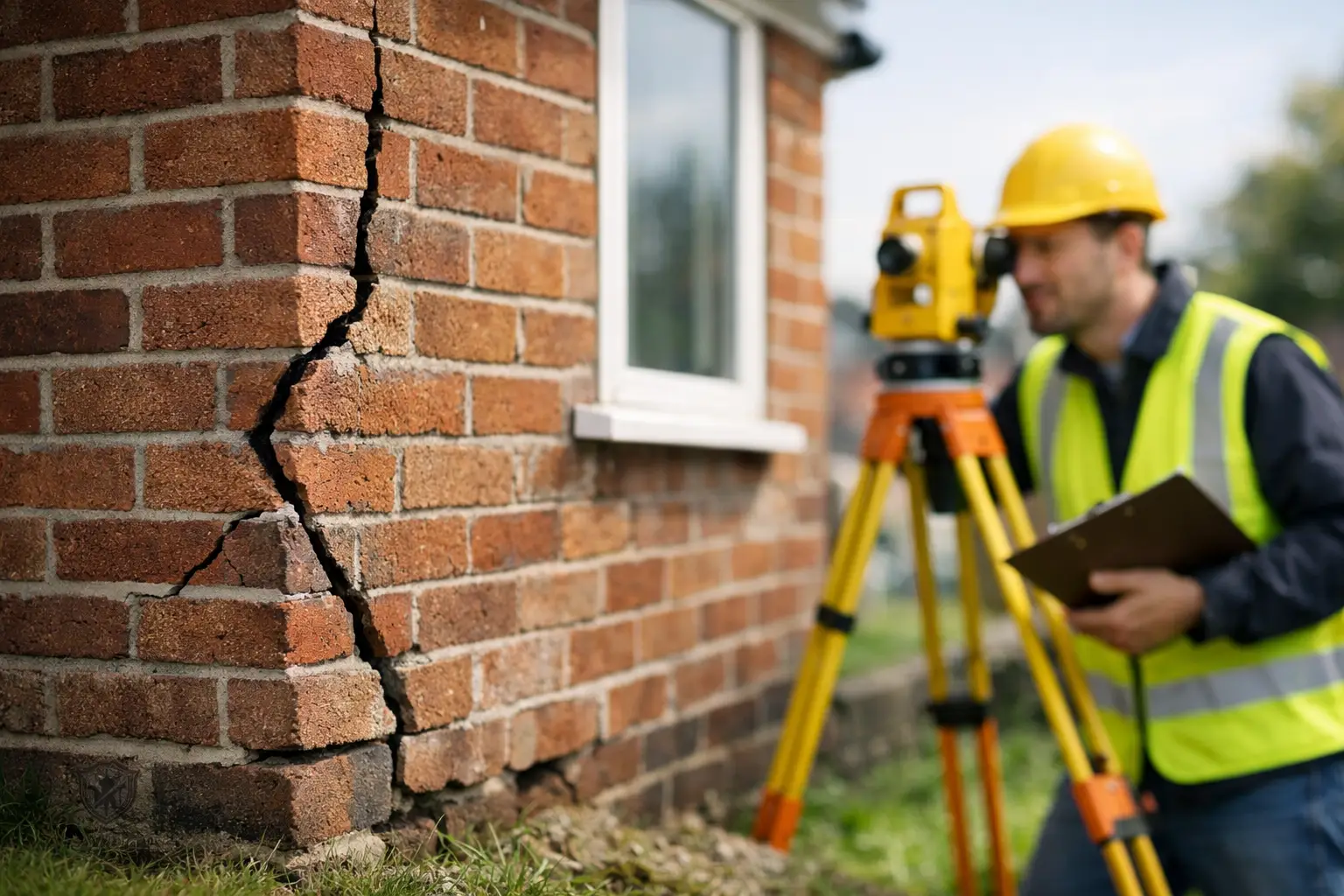
A stepped crack above a window, a door that suddenly binds, or a floor that no longer feels level can change the economics of a property before a price has even been agreed. A survey for subsidence is not simply a box-ticking exercise for a worried buyer. It is a technical investigation that can determine whether a defect is historic and manageable, active and costly, or unrelated to ground movement altogether.
For sellers, a clear diagnosis avoids late-stage renegotiation or a buyer walking away after a mortgage valuation. For investors and developers, it is the difference between pricing a controlled refurbishment and inheriting an open-ended structural risk. The right survey creates evidence. Evidence creates a defensible decision.
What a survey for subsidence is designed to establish
Subsidence occurs when the ground beneath a building loses support or moves downward unevenly. The resulting movement can place stress on walls, openings, drains and internal finishes. However, cracking alone does not prove subsidence. Buildings move for many reasons, including thermal expansion, drying timber, settlement in older construction, roof spread, poor alterations and localised failure of finishes.
A properly scoped survey for subsidence seeks to answer several commercial questions: is movement present; is it likely to be active; what is causing it; how far has damage progressed; and what work is required to stabilise and reinstate the property?
The surveyor will review the building’s form, age, construction and visible defects. They will assess crack patterns, distortion around openings, floor levels, roof lines, drainage, nearby trees, ground conditions and evidence of previous repairs. The objective is not to attach a dramatic label to every crack. It is to separate cosmetic symptoms from movement that affects value, finance, insurance or buildability.
When a specialist investigation is justified
Not every property with cracked plaster needs an engineer-led investigation. Hairline, random cracks within a modern plaster finish are common, particularly after redecoration, seasonal changes or minor settlement. The risk increases where cracking is diagonal, wider at one end, visible both internally and externally, or concentrated around doors and windows.
A more detailed assessment is normally justified where there is clear distortion, recurring cracks after repair, sticking doors and windows across more than one area, sloping floors, separation between extensions and the original house, or a history of insurance claims. It is also prudent where the property sits on clay soil near mature trees, has leaking drains, or has undergone significant structural alteration.
For an acquisition, the timing matters. If concerns arise during viewing or in a homebuyer report, do not treat the issue as a post-completion maintenance item. Establish the likely cause before exchange where possible. The cost of a targeted survey is usually small beside the exposure created by an incorrectly priced purchase, a lender retention or an insurer declining to continue cover.
The investigation should match the evidence
The phrase ‘subsidence survey’ is used broadly, but the appropriate work depends on the property and the defects observed. A competent building survey may be sufficient to identify whether symptoms are consistent with movement and to recommend the next step. Where the evidence is stronger, the investigation may need input from a structural engineer, drainage contractor, arboriculturist or geotechnical specialist.
Building inspection and defect mapping
The first stage is usually a detailed inspection. The surveyor records the location, direction and approximate width of cracks, alongside distortion and material condition. This establishes whether defects follow a pattern consistent with localised movement or whether they are more likely linked to construction detailing, age or isolated deterioration.
Photographs matter, but measured records matter more. A documented baseline allows future movement to be assessed rather than guessed. On investment projects, this evidence should sit alongside measured floorplans, title review, planning constraints and a costed scope of works.
Monitoring, drainage and ground assessment
Where active movement is uncertain, crack monitoring may be installed over time. This can feel slow when a transaction is moving, but monitoring has a purpose: it distinguishes a historic defect from a live problem. A property with long-settled movement may be financeable and repairable within a predictable budget. A building still moving requires a more cautious approach.
Drainage surveys are often central. Escaping water can soften or wash away supporting ground, while defective drains near shallow foundations can contribute to localised settlement. On shrinkable clay, mature trees and extensive vegetation may extract moisture from the soil, causing seasonal movement. The cause must be addressed before cosmetic repairs are specified. Filling cracks without fixing the mechanism is not a repair strategy.
In more complex cases, trial pits or boreholes may be recommended to establish foundation depth and ground composition. These investigations are disruptive and should be commissioned only where the likely benefit justifies the cost. Their value lies in replacing assumptions with information that can support engineering design, insurer discussions and a realistic programme.
What the findings mean for value and finance
A survey does not automatically make a property unmortgageable or unsuitable for investment. The outcome depends on cause, activity, extent, insurance history and the lender’s criteria. A historic claim with documented repairs and continuing insurance can be very different from unexplained active cracking in a property with no records.
For owner-occupiers, the immediate concern is often whether they can obtain a mortgage and insure the building. For investors, the analysis goes further. The purchase price must reflect the cost of investigation, professional design, remedial works, delay, contingency and the potential impact on the exit market. Future buyers will ask the same questions. Their surveyors and lenders will review the same visible evidence.
Underpinning is often assumed to be the inevitable answer, but it is not. Depending on the cause, repairs may involve drain renewal, tree management, localised foundation improvement, masonry repairs or monitoring followed by reinstatement. Underpinning can be appropriate, but it is expensive, disruptive and not a substitute for identifying why movement occurred.
A disciplined appraisal should allow for more than the contractor’s headline figure. Include access constraints, temporary works, professional fees, party wall implications, reinstatement finishes, time costs and a meaningful contingency. In London and other dense urban areas, restricted access and neighbouring structures can materially affect both method and cost.
How sellers should handle suspected subsidence
Concealing known issues is a poor strategy. Buyers will commission surveys, lenders may raise queries and the transaction can fail at the point when alternatives are limited. If there has been a previous claim or repair, gather the documentation early: insurer correspondence, engineers’ reports, completion certificates, guarantees, monitoring records and details of any work undertaken.
A seller does not always need to complete every repair before marketing. In some situations, a buyer with construction capability may prefer to acquire the property at an adjusted price and take control of the works. What matters is clarity on the defect, the available evidence and the basis on which the price has been agreed.
For homeowners who need speed or certainty, a technically informed buyer can assess risk directly rather than relying on vague allowances. That does not make subsidence irrelevant. It makes transparent information more valuable, because the deal can be structured around the actual condition of the asset.
A practical decision process for buyers and investors
When movement is suspected, avoid jumping from a visual crack to a reduced offer or a rejection. Start by reviewing the available paperwork and arranging an appropriately qualified inspection. Then establish whether the report identifies active movement, a probable cause and a defined next step.
If the evidence points to historic and stable movement, assess the quality of prior repairs, insurance continuity and resale implications. If the cause is identifiable and the remedy is proportionate, price the work with professional input and retain contingency. If the property requires prolonged monitoring, invasive investigation or major structural intervention, the decision becomes more commercial: can the purchase price, funding structure and programme absorb the uncertainty?
There are situations where walking away is the correct outcome. This is particularly true where the cause remains unclear, the seller cannot provide records, access for repairs is constrained, or the projected margin depends on optimistic costs. A good acquisition process does not force every opportunity into a deal. It removes avoidable uncertainty and prices the residual risk properly.
The report is only useful if it changes the decision
The strongest survey reports do more than describe cracks. They set out observations, likely causes, limitations, recommended investigations and a reasoned view of urgency. They give the buyer, seller, lender and insurer a common factual basis from which to act.
At Sentinel Property Ventures, surveying and construction review sit at the start of the appraisal, not after the offer has been made. That approach is useful whether a property needs a straightforward refurbishment or a more cautious structural strategy.
A suspected subsidence issue should slow down assumptions, not necessarily stop a transaction. Get the right evidence, identify the cause, cost the remedy honestly and let the numbers decide whether the property still works.