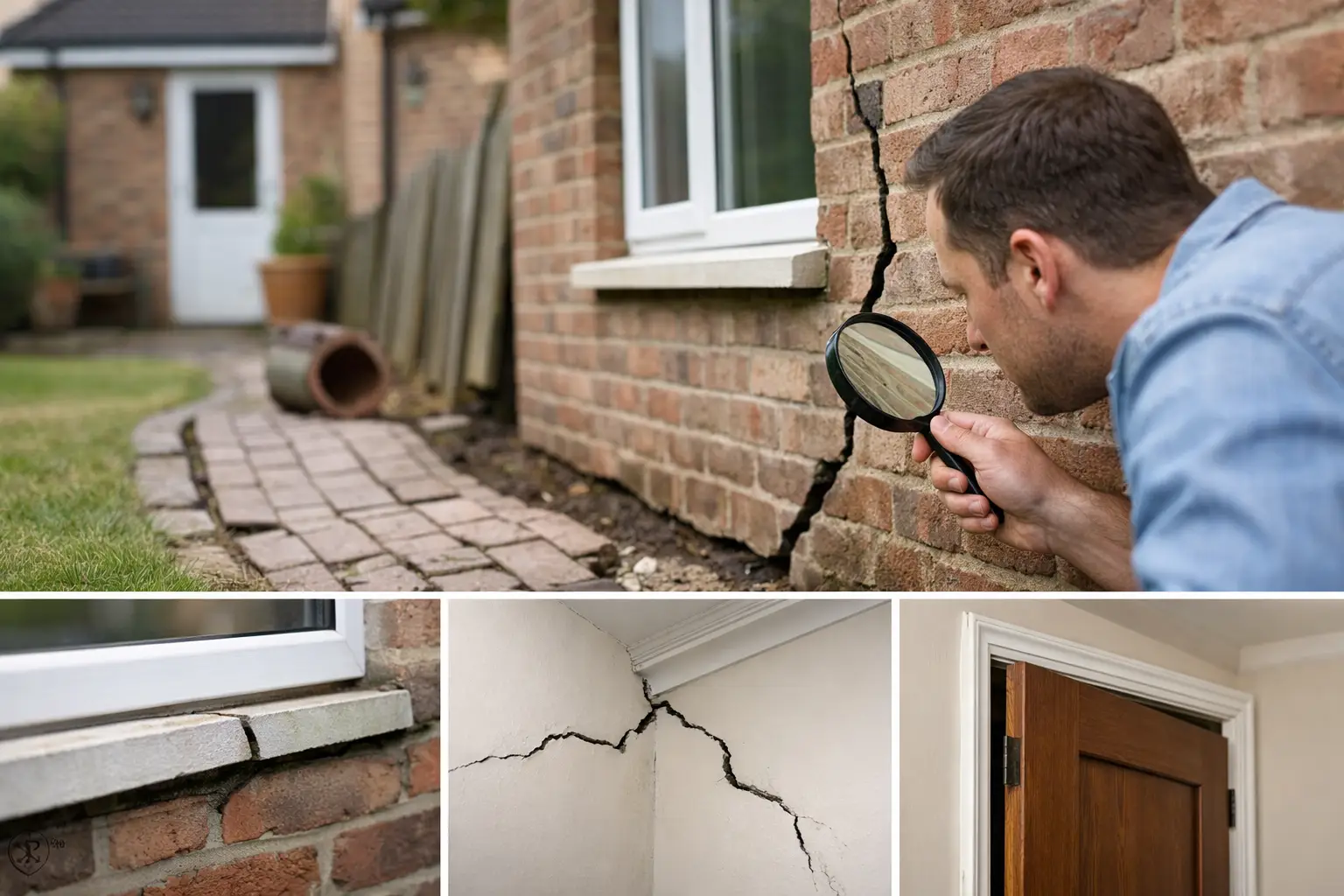
A crack above a window is not automatically a subsidence claim. Equally, dismissing it as cosmetic without checking the building can turn a manageable issue into a costly delay, particularly when a sale, refinance or refurbishment is planned. The key subsidence warning signs are patterns of movement, not isolated defects. They need to be read alongside the property’s age, construction, ground conditions and recent changes around the site.
For homeowners, early investigation protects value and keeps control of the selling process. For investors, it is a due-diligence issue: movement risk affects acquisition price, scope of works, insurance, funding and exit strategy. The right response is measured assessment, not guesswork.
What subsidence actually means
Subsidence occurs when the ground supporting a building moves downwards unevenly. One part of the structure loses support or settles more than another, placing stress on walls, openings and finishes. The resulting movement is usually differential, which is why cracking often appears diagonally rather than as an even settlement line.
It is different from ordinary settlement. Many older properties have historic cracks from construction, seasonal changes or decades of minor movement. These may be stable and need only local repair. Subsidence is a live or potentially live ground-movement issue, and the question is whether the movement is progressing, what is driving it and whether the structure has been affected.
Heave is the opposite movement, where ground rises. It can occur after a mature tree is removed from shrinkable clay, allowing moisture levels to recover and the ground to expand. Both conditions require proper diagnosis before repairs are specified.
The main subsidence warning signs to inspect
No single sign proves subsidence. A cluster of symptoms, especially where they are concentrated on one elevation or around a particular corner, should prompt further investigation.
Diagonal cracks around doors and windows
Cracks caused by movement commonly run diagonally from the corner of a window or door opening. They may be wider at one end and pass through brickwork rather than simply following mortar joints. Cracking over roughly 3mm, cracks that are widening, or cracks visible both internally and externally deserve particular attention.
Fine hairline cracks in plaster are common, especially in refurbished homes where materials dry at different rates. They are not usually a structural concern in isolation. The concern increases where the crack reappears after filling, opens seasonally, or is accompanied by distortion elsewhere.
Cracks through brickwork and render
External brickwork provides useful evidence because it is less easily disguised than internal decoration. Look for stepped cracking along mortar joints, fractured bricks, separation at extensions, or a crack that continues from the external wall through to internal finishes.
Render can conceal masonry movement until it fails. Bulging, hollow-sounding or locally cracked render should not be assumed to be cosmetic. It may simply be a render defect, but it can also obscure the line and extent of underlying cracking.
Doors and windows that suddenly stick
A door that has always caught in damp weather is not necessarily a concern. A door or window that suddenly jams, develops uneven gaps, or will no longer sit square in its frame can indicate that an opening has distorted.
Check whether the issue is localised. If several doors or windows on the same side of the house are affected alongside cracking, the evidence is more meaningful than one swollen timber door in a poorly ventilated room.
Sloping floors and separated finishes
Floors can slope for many reasons, particularly in Victorian and older properties with timber suspended floors. What matters is change. A noticeable new slope, gaps opening between skirting boards and floors, or ceilings separating from walls may indicate movement in the supporting structure.
Extensions are also worth inspecting carefully. A visible gap where an extension meets the original house may be a result of different foundations, poor detailing or historic movement. It needs to be assessed in context rather than treated as an automatic deal-breaker.
Movement in external features
Cracked paths, sunken patios and leaning boundary walls can be caused by shallow foundations, poor drainage or tree roots without affecting the main dwelling. They are still useful clues. If external movement aligns with cracking to the house, there may be a common ground or drainage issue to investigate.
Why properties move
In London, the South East and parts of the Midlands, clay soil is a frequent consideration. Clay shrinks as it dries and expands as it takes on moisture. Mature trees and shrubs can intensify drying close to foundations, while prolonged weather patterns can make underlying susceptibility more visible.
Drains are another regular cause. A leaking drain can wash away or soften ground beneath or adjacent to a property. Older homes with original or poorly maintained drainage runs warrant particular scrutiny. A CCTV drain survey may identify defects that are not visible from the surface and can be significantly cheaper to address than structural work undertaken without resolving the cause.
Other factors include poorly compacted ground below an extension, escaping water from supply pipes, nearby excavation, mining-related conditions in relevant areas and alterations that have changed how water drains across the site. A nearby tree is not automatically the culprit, and removing it without advice can create heave risk. Cause comes before remedy.
How to assess suspected movement properly
Start with a factual record. Photograph cracks with a scale, note their location, measure their width and record the date. Repeat photographs from the same position over time. This creates evidence of whether a defect is stable, seasonal or worsening.
Next, inspect the practical causes that can be checked without invasive work. Clear blocked gutters, identify overflowing gullies, review surface-water falls, and note nearby trees, recent building works and changes in ground level. Do not patch major cracks before documenting them. Decoration can hide evidence but it does not resolve movement.
Where the pattern is concerning, instruct an appropriately qualified building surveyor or structural engineer. Their role is to distinguish between superficial cracking, historic settlement, thermal movement, foundation-related movement and active subsidence. Depending on the evidence, they may recommend level monitoring, crack monitoring, a drain survey, trial pits, soil investigation or arboricultural advice.
Monitoring can feel slow when a sale is pending, but it is sometimes the commercially correct route. Insurers and lenders may need evidence that movement has stopped before they accept a repair strategy. Conversely, clear evidence of a local drainage defect may allow a targeted repair and avoid extended monitoring. The scope should match the risk, rather than defaulting to the most expensive investigation.
What not to do
Avoid assuming that underpinning is the standard answer. It is a substantial intervention and is only appropriate where investigation shows the foundations need strengthening or deeper support. Many movement cases are resolved by repairing drains, managing vegetation, improving drainage or addressing a local construction defect.
Do not rely solely on an estate agent’s description, a neighbour’s opinion or a previous coat of paint. A property can have historic subsidence with an accepted insurance history and no current movement. It can also look tidy while a live issue develops behind newly applied finishes. The documentation matters: past claims, engineers’ reports, completion certificates, monitoring records and details of remedial works should all be reviewed.
Finally, do not conceal known defects when selling. Sellers are expected to answer property information enquiries accurately, and a buyer’s survey may identify the issue regardless. Late disclosure often creates more friction than early, documented explanation.
Selling or buying a property with possible subsidence
A suspected issue does not make a property unsellable, but it changes the transaction. A conventional buyer may need mortgage approval, specialist insurance confirmation and time for surveys. That can introduce uncertainty, renegotiation and delay. A cash buyer with construction and surveying capability may be able to assess risk more directly, but the price will reflect the evidence, remedial cost, programme impact and resale position.
For an investor, the acquisition decision should separate the visible defect from the actual liability. Price the investigation, likely repair, contingency, insurance implications, holding costs and potential exit restrictions. A well-documented historic case can be more straightforward than an unexplained crack in an otherwise attractive property.
Sentinel Property Ventures approaches distressed and technically complex residential opportunities through measured inspection, documented due diligence and a clear view of refurbishment scope. That discipline is particularly valuable where movement risk could otherwise be misunderstood or priced on assumption.
If you see subsidence warning signs, act early, record what you find and obtain an informed assessment before committing to repairs or a transaction. Certainty comes from evidence, and evidence gives owners and buyers room to make a controlled commercial decision.